How to Create a Lead Magnet: Guide for Online Tutors
Most visitors who land on your tutoring website will leave without doing anything. They'll read your services page. Maybe browse your about page. And then they're gone and you have no way to follow up with them.
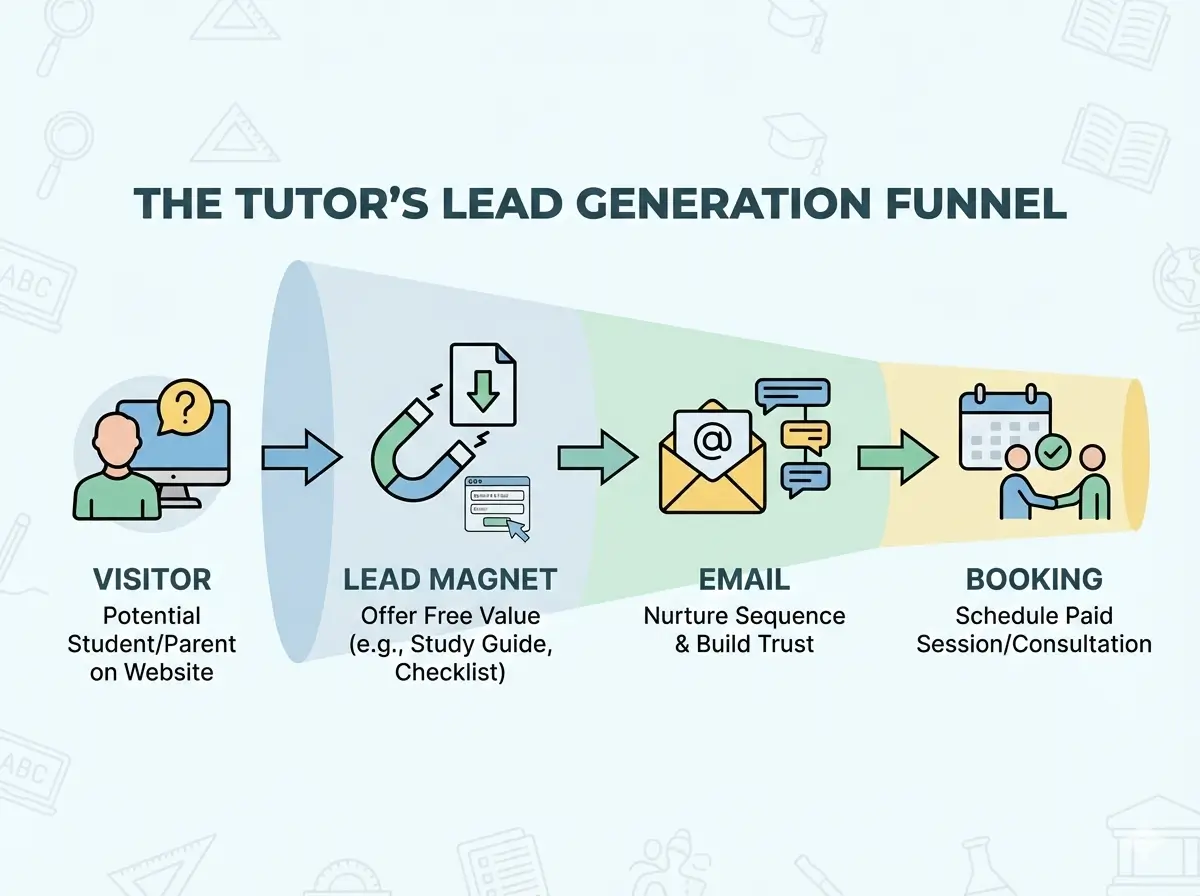
A lead magnet changes that. When you offer a free, valuable resource in exchange for an email address, you turn anonymous visitors into warm leads. And once you have their email, you can nurture them with helpful content, build trust over time, and eventually guide them toward booking.
Hi, I am Abdur, founder of Mabit Web Studio. For the past three years, I've been helping education businesses grow with conversion-focused websites and effective marketing strategies.
In this guide, I'll show you exactly how to create a lead magnet that works for your tutoring business, from picking the right type to promoting it on your website and following up with the right emails.
Table of Contents
What Is a Lead Magnet for Online Tutors?
A lead magnet is a free, high-value resource you offer to visitors in exchange for their contact information, usually an email address. It sounds simple, but it's one of the most powerful tools in your marketing funnel.
Here's why: most people who visit your tutoring website aren't ready to book right away. They're researching. Comparing options. Thinking it over. If they leave without giving you their contact info, they're gone forever.
But if you offer them something genuinely useful, like a free study guide, a quiz, a short video lesson, they'll trade their email for it. Now you have a direct line of communication. You can send helpful content, build trust, and stay top-of-mind until they're ready to book.
Generic PDF vs targeted tutoring lead magnet:
A generic PDF titled "Study Tips for Students" doesn't convert well. It's vague. Every other tutoring website has something like it.
A targeted lead magnet like "Free SAT Math Formula Sheet: 40 Formulas You Need to Memorize" is specific, immediately useful, and directly relevant to what your ideal student needs. That's what converts.
Core Principles of a Great Tutoring Lead Magnet
Before we get into types and formats, here's what separates a lead magnet that converts from one that doesn't:

1. Specific and Focused
One problem. One outcome. One clear result.
"Study tips" is too broad. "How to raise your SAT Reading score by 50 points in 4 weeks" is specific.
The more targeted your lead magnet, the more it will resonate with the exact students you want to attract.
2. Immediately Useful
The person who downloads your lead magnet should be able to use it right away today, not after booking sessions.
If a student downloads your "SAT Math Formula Sheet," they should be able to start using it to study immediately. That immediate value builds trust faster than anything else.
3. Easy to Consume
Keep it short. Keep it visual. Make it skimmable.
A 30-page PDF is not a good lead magnet. A well-designed 3-page formula sheet is. A 6-part email course is overwhelming. A 5-minute quiz is not.
The goal is for people to actually use it and feel the value, not just download it and forget about it.
4. Aligned With Your Offer
The lead magnet should naturally prepare the reader for your services.
If you're an SAT prep tutor, your lead magnet should help students realize they need expert preparation and that you're the right person to provide it. The free resource leads them toward booking, not away from it.
Types of Lead Magnets for Tutors
Not every lead magnet suits every online tutoring niche. Here's a breakdown of the best types and who they suit:
1. Free Study Guides
Subject-specific guides, formula sheets, concept summaries, or exam checklists.
Examples:
- "SAT Math Formula Sheet: Every Formula You Need"
- "GCSE Chemistry Key Concepts Summary"
- "Spanish Verb Conjugation Quick Reference Guide"
This is best for: Exam-prep tutors, subject-specific tutors, and anyone whose students need quick reference materials.
They are Immediately useful. Students use it right away and associate the value with you. Every time they study, they see your name.
2. Assessment or Quiz
A diagnostic test, learning-style quiz, or "what score can you achieve?" assessment.
Examples:
- "What's Your SAT Math Weakness? Take the 5-Minute Assessment"
- "Discover Your Learning Style: Free Quiz for High Schoolers"
- "How Ready Are You for Your Chemistry Exam? Free Diagnostic Test"
This is best for: Data-driven tutors, test-prep specialists, and tutors who want to show personalized value.
They are interactive and personalized. People love learning about themselves. It also gives you valuable data about your leads, you know their specific challenges before you even speak to them.
3. Mini-Course or Video Lesson Series
3-5 short video lessons (5-10 minutes each) on a specific topic.
Examples:
- "5-Day SAT Math Bootcamp: Free Video Series"
- "Learn Basic Spanish Grammar in 5 Short Lessons"
- "How to Study for Chemistry Exams: A 4-Video Guide"
This option is best for tutors who are comfortable on camera and want to showcase their teaching style before the first consultation.
Video builds trust faster than any written format. By the end of the mini-course, students feel like they already know you, which makes booking a session a much easier decision.
4. Resource List
A curated list of the best tools, websites, apps, or books for a specific subject or exam.
Examples:
- "Top 10 Free SAT Prep Resources Students Actually Use"
- "Best Apps for Learning Spanish in 2025"
- "Chemistry Study Tools: Apps, Websites, and Books That Work"
This is best for online tutors who serve students who are self-directed learners or parents who are researching on behalf of their child.
They are quick to create and easy to consume. Parents love resource lists because they want to help their child but don't know where to start.
5. Free Trial Class or Consultation
A free 20-30 minute tutoring session or discovery call.
Examples:
- "Book a Free 20-Minute SAT Math Consultation"
- "Try a Free Spanish Lesson: No Commitment Required"
This option is good for online tutors who are highly personable, tutors offering premium pricing, and anyone whose conversion relies heavily on relationship-building.
This works because it’s the most direct path to booking. If your session is good, they'll enroll. The downside is it requires your time for every lead.
Choose the Right Lead Magnet for Your Niche
Not sure which type to pick? Use this simple framework:
1. Match the lead magnet to your audience's biggest pain point
What's the one thing your ideal student or parent worries about most? A student preparing for SAT wants to score higher. A parent of a struggling math student wants to understand where their child is falling behind. Start there.
2. Consider your teaching style and format preferences
If you hate being on camera, don't create a mini-course. If you love data and assessments, build a quiz. If you're great at writing clear explanations, create a study guide. The best lead magnet is one you'll actually create and promote.
3. Think about scalability
Can you create it once and use it indefinitely? A study guide or quiz is scalable. A live consultation is not (it requires your time every time).
4. Look at what you already have
Blog posts, lessons, slides, notes from student sessions, all of this is raw material for a lead magnet. Don't start from scratch. Repurpose content you've already created.
Step-by-Step: How to Create Your Lead Magnet
Step 1: Pick a Clear Outcome
What will your reader know, feel, or be able to do after consuming your lead magnet?
Write it in one sentence: "After downloading this, a student will know the 40 most important SAT Math formulas and how to use each one." That clarity guides everything else you create.
Step 2: Outline the Content
Keep it simple. Use bullet points to outline what's included.
Example for a study guide:
- Introduction (why these formulas matter)
- Algebra formulas (with examples)
- Geometry formulas (with examples)
- Advanced math formulas
- Quick practice problems
- Cheat sheet summary
Don't overthink it. A clear, simple outline beats a complicated one every time.
Step 3: Design It
You don't need to be a designer. Here are the tools:
- Canva: The easiest option. Pre-built templates for ebooks, checklists, and resource guides. Free version is more than enough to start.
- Google Docs / Google Slides: Simple, clean, professional. Great for study guides and resource lists.
- Video recording (Loom, OBS, or your phone): For mini-courses and video lessons. Keep it simple and authentic. A phone camera and a quiet room is enough.
- Typeform or Google Forms: For quizzes and assessments.
Design doesn't have to be beautiful. It has to be clear and useful.
Step 4: Turn It Into a Deliverable
Export your Canva design or Google Doc as a PDF. Upload it to Google Drive, Dropbox, or your email platform.
For video lessons, upload to a private YouTube playlist or a simple course page on your website.
For quizzes, set up a Typeform that sends results via email.
Step 5: Test It
Before you launch, send it to 2-3 current students or parents and ask for honest feedback:
- Was it easy to use?
- Was it immediately helpful?
- Is anything confusing?
A quick test saves you from launching something that doesn't land.
How to Promote Your Lead Magnet on Your Website
Creating the lead magnet is only half the work. If people can't find it, it won't convert.
1. Popup Forms with Strategic Timing
Don't show a popup the moment someone lands on your page. That's annoying and intrusive.
Instead, trigger it after 30-45 seconds on the page or after they've scrolled 50% down. This filters for engaged visitors, people who are actually reading your content.
Exit-intent popups are also effective. When a visitor moves their mouse toward the browser's close button or back arrow, trigger a popup: "Before you go, download our free SAT Math Formula Sheet."
2. Embedded Forms in Blog Posts and Service Pages
Place your lead magnet opt-in form directly inside your content. After a relevant section in a blog post, add: "Want this as a downloadable checklist? Get it free here."
On your service pages, include a section specifically for your lead magnet. "Not ready to book yet? Start with our free [resource] and see how we can help."
3. Dedicated Landing Pages
For each lead magnet, create a dedicated landing page, no navigation, no distractions. Just the offer and a form.
Landing pages focused on a single goal convert significantly better than pages with multiple links and options competing for attention.
4. Tools to Manage It
For email delivery and automation, Mailerlite (We mostly use this one at Mabit Web Studio), Mailchimp or ConvertKit (better for creators, starts free) are solid options for online tutors just getting started.
For live chat that can capture leads, Tawk.to is free and works well.
For a complete guide on integrating lead magnets into your tutoring website (including landing page structure and popup placement), check out my comprehensive article: How to Build a Website For Your Tutoring Business.
How to Follow Up With an Email Sequence
Getting the email is just the beginning. What you do next determines whether that lead becomes a student.
Email 1: Welcome + Instant Delivery (Send immediately)
Deliver the lead magnet right away. Don't make people wait.
Subject: "Here's your [Lead Magnet Name] "
Content: A warm welcome, the download link, and one sentence about who you are and how you help. Keep it short.
Email 2: Value Email (Day 2)
Send something useful, no selling! A quick tip, a common mistake to avoid, or a mini lesson related to your lead magnet topic. Build trust before you ask for anything.
Email 3: Value Email + Soft Introduction to Your Services (Day 4)
Share another helpful resource and naturally introduce what you offer.
"By the way, if you'd like personalized help with [topic], I offer free consultation calls. Here's how it works." Keep it conversational and low-pressure.
Email 4: Case Study or Testimonial (Day 7)
Share a success story. "One of my students used this exact approach and went from a 1150 to a 1380 on the SAT in 8 weeks."
Proof builds conviction. This email moves leads from "interested" to "I should book."
Email 5: Direct CTA (Day 10)
Make a clear, direct offer: "If you're ready to work together, here's how to book your free consultation." One link. One call to action. Simple.
This 5-email sequence over 10 days is enough to warm a cold lead into a consultation-ready one. Keep each email short (under 200 words) and genuinely helpful.
Common Lead Magnet Mistakes Online Tutors Make
Mistake 1: Making It Too Broad or Generic
"Free Study Tips PDF" sounds like something every other tutoring website offers. And it is!
The more specific your lead magnet, the more it resonates with the exact student you want to attract. Narrow it down to one subject, one problem, one exam.
Mistake 2: Over-Promising and Under-Delivering
"Learn everything you need to ace the SAT in this free guide" is an impossible promise. When the guide doesn't deliver that result, trust is broken immediately.
Be honest about what your lead magnet does. "A concise reference sheet for the 40 most-tested SAT Math formulas" sets an expectation you can actually deliver.
Mistake 3: Forgetting a Clear Next Step
Your lead magnet should always end with a clear next action. "If you found this helpful and want personalized coaching, book a free 20-minute consultation here."
Without a next step, the lead magnet is just a free resource that doesn't contribute to your business.
Mistake 4: Never Testing Different Formats
Some audiences respond better to quizzes. Others prefer checklists. Others want video.
If your first lead magnet doesn't convert well, don't give up! Test a different format or topic. Data tells you what your specific audience actually wants.
Conclusion
A well-designed lead magnet is one of the highest-leverage investments you can make for your tutoring business.
It turns anonymous visitors into warm email subscribers. It builds trust before the first consultation. It keeps you top-of-mind while leads are deciding whether to book.
The key is to keep it specific, keep it useful, and make sure it naturally leads toward your services.
Key Takeaways:
- A lead magnet is a free resource that earns you an email address and the ability to follow up
- The best tutoring lead magnets are specific (one problem), immediately useful, easy to consume, and aligned with your offer
- Best lead magnet types for tutors: study guides, quizzes/assessments, mini-courses, resource lists, and free consultations
- Choose based on your audience's biggest pain point and your own strengths (writing vs video vs interactive)
- Create it in 5 steps: clear outcome > outline > design (Canva/Google Docs) > deliverable > test
- Promote it with timed popups, embedded forms, and dedicated landing pages
- Follow up with a 5-email sequence over 10 days: deliver > value > soft pitch > proof > CTA
- Avoid: generic topics, overpromising, missing CTAs, and never testing alternatives
Your lead magnet is just one piece of a complete tutoring website strategy. For a step-by-step guide on building a website that attracts students and converts visitors into bookings, including how to integrate lead magnets into your sales funnel, check out: How to Build a Website For Your Tutoring Business.
And if designing and setting up your website feels overwhelming, that's exactly what we do at Mabit Web Studio. We build conversion-focused websites for online tutors, with lead magnet integration, email forms, and landing pages built in. Schedule a free consultation to discuss your project.