How to Build a Sales Funnel for Your Education Business
Most education businesses struggle with the same problem: they get website visitors, social media followers, and even inquiries, but very few actually convert into paying students.
The reason is that without a clear system, you're relying on hope. You hope people find your website. You hope they click around. You hope they remember you when they're ready to enroll. That's not a business strategy, that's a gamble.
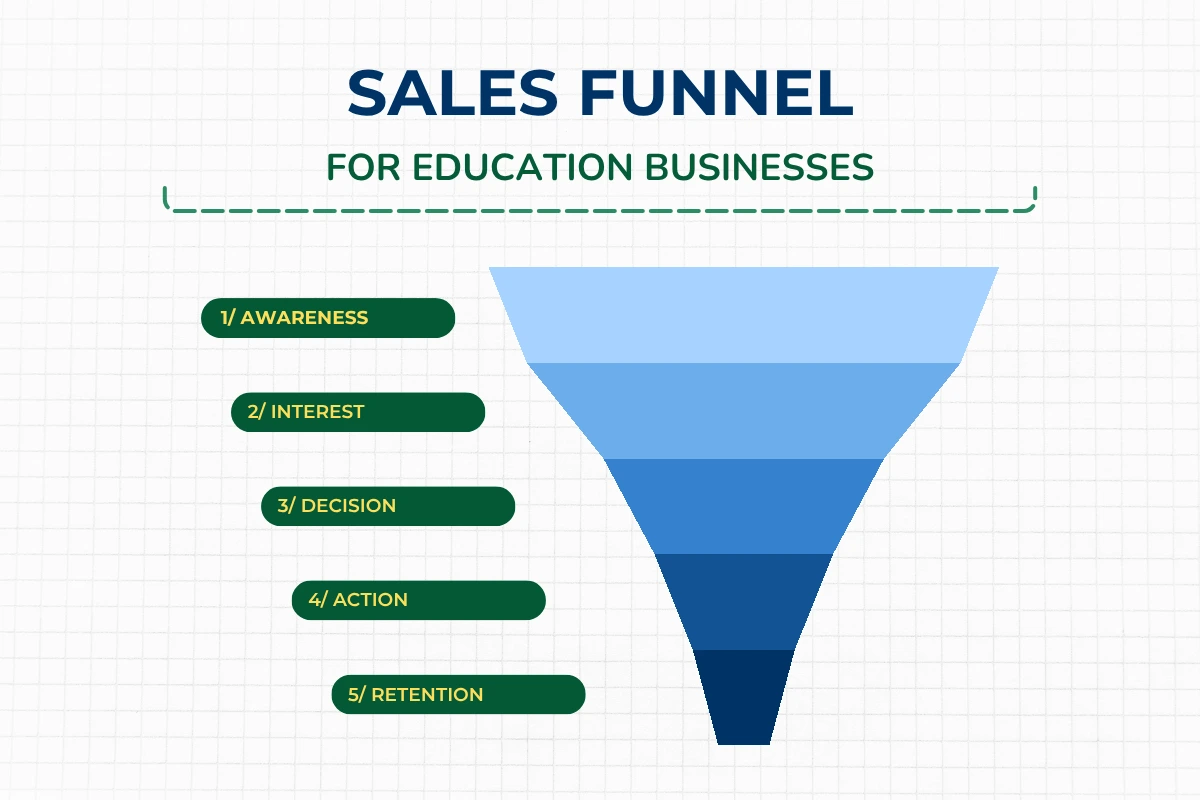
A sales funnel is a systematic approach that guides prospective students from "I've never heard of you" to "I'm ready to enroll." Instead of random marketing efforts, you have a clear path that consistently converts prospects into students.
Hi, I am Abdur, founder of Mabit Web Studio. For the past three years, I’ve been helping online education businesses grow with conversion-focused sales funnels.
In this article, I will explain how to build a sales funnel for your education business. You'll learn what a sales funnel actually is, why it's essential for education businesses, the stages every funnel needs, and a step-by-step process to build your own. By the end, you'll have a clear roadmap to create a funnel that works for your specific education business.
Table of Contents
What is a Sales Funnel?
A sales funnel is the journey a prospect takes from discovering your education business to becoming a paying student.
Think of it like an actual funnel. At the top, it's wide - lots of people discover you through various channels. As they move down the funnel, the number decreases, but those remaining become more interested and qualified. At the bottom, a smaller number converts into paying students.
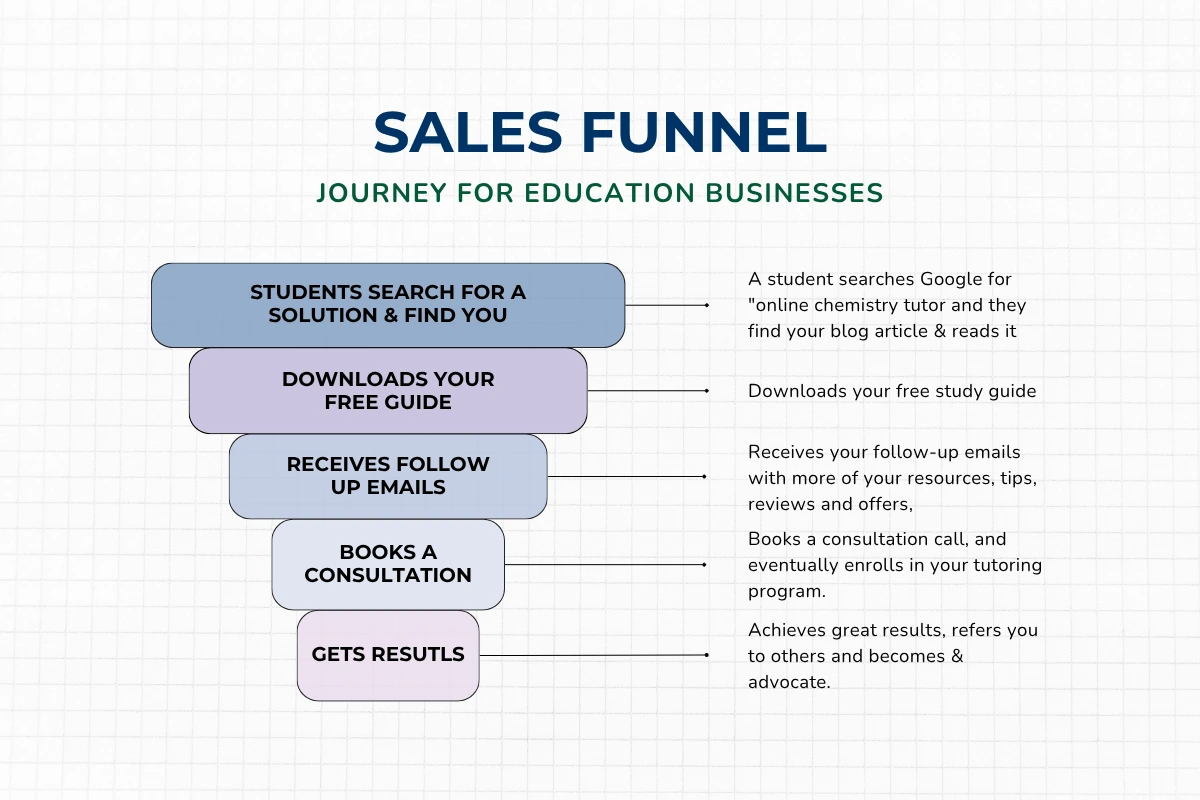
Here's a simple example of the funnel process:
- A student searches Google for "online chemistry tutor and they find your blog article
- Downloads your free study guide,
- Receives your follow-up emails with more of your resources, tips, reviews, and offers
- Books a consultation call, and eventually enrolls in your tutoring program
- Achieves great results, refers you to others, and becomes an advocate
This entire journey is your sales funnel.
The keyword here is "journey." A sales funnel isn't about pushing sales immediately. It's about guiding prospects through stages, building trust, and making it easy for them to say yes when they're ready.
What makes a sales funnel different from inconsistent marketing? Inconsistent marketing means posting on social media without a strategy, hoping someone finds your website, and crossing your fingers that they contact you.
A sales funnel is intentional. Every piece of content, every email, every page has a specific purpose and leads to the next step.
Without a funnel, you're hoping prospects figure things out on their own. With a funnel, you're actively guiding them toward enrollment.
Why Your Education Business Needs a Sales Funnel?
I have to be honest here, most education businesses operate reactively. They create content, post on social media, and wait for students to come to them. Some months are great. Other months are slow. Income is unpredictable.
A sales funnel solves this by creating a predictable student acquisition system. When you know exactly where your leads come from and what path they take to become students, you can replicate and scale that process.
Here's what a sales funnel gives your education business:
1. Predictable student acquisition
You know that if 1,000 people visit your blog, 100 will download your lead magnet, 20 will book consultations, and 5 will enroll. These numbers might not be perfect initially, but you can track and improve them over time. That's predictability.
2. Better conversion rates
Instead of hoping prospects figure out how to work with you, you guide them through a proven path. When you actively nurture leads with valuable content and clear next steps, conversion rates increase significantly. Education businesses with documented funnels typically see 2-3x better conversion rates than those without.
3. Time and resource efficiency
A sales funnel automates parts of your student acquisition process. Once you create a lead magnet and email sequence, they work for you 24/7. You're not manually chasing every single lead or repeating the same information in every conversation.
4. Scalability
A documented funnel can be replicated. If one blog article brings in students through your funnel, you can create more articles. If one lead magnet works well, you can create variations for different niches. That’s why with a funnel, growth is systematic.
5. Data-driven decisions
You can track what works and what doesn't at each stage. If people download your lead magnet but don't read your emails, you know the problem is your email content, not your traffic. If people book consultations but don't enroll, you know to improve your sales conversation, not your marketing.
What happens without a sales funnel? You experience inconsistent income, waste your marketing budget on tactics that don't convert, and rely almost entirely on word-of-mouth referrals. There's nothing wrong with referrals, but building a business solely on them means you're never fully in control of your growth.
Understanding Sales Funnel Stages
Every sales funnel has stages that mirror how people make buying decisions. Understanding these stages helps you create the right content and offers for each step.

Stage 1: Awareness
This is where prospects discover your education business. Students aren’t looking for you, they are looking for solutions to their problems.
Their mindset at this stage is: "I need help with x,y,z, but I don't know who can help me yet."
Your goal here is simple: appear in the places where your audience is looking for solutions to their problem.
If a student is struggling with calculus, and they go to YouTube and your explanation video on calculus appears right in front of them, you have just built awareness. Now that students know you exist.
Examples of awareness content include blog articles that answer common questions, social media posts with tips and insights, YouTube videos teaching concepts, and podcast appearances where you share your expertise.
The key metrics to track: traffic, impressions, and reach. How many people are discovering you?
Stage 2: Interest
At this stage, prospects want to learn more about potential solutions. They're researching options and comparing different educators or programs.
Their mindset: "I know I need help, and I'm exploring different tutors/courses/programs to see who's the best fit."
Your goal is to build trust and showcase your expertise beyond a single blog post. This is where you collect their contact information (usually email) so you can continue the conversation.
Examples include email sequences that provide ongoing value, webinars or workshops that dive deeper into topics, free mini-courses that demonstrate your teaching style, and lead magnets like downloadable guides or templates.
The key metrics to track: email sign-ups, engagement rate, and how much time they're spending with your content.
Stage 3: Decision
Prospects at this stage are evaluating whether you're the right fit for their specific needs. They're comparing your services to competitors, looking at pricing, and reading reviews or testimonials.
Their mindset: "I think this educator might be right for me, but I need to be sure before I commit."
Your goal is to address objections and demonstrate the value you provide. This is where social proof becomes crucial.
Examples include case studies showing specific student results, testimonials from past students or parents, consultation calls where you understand their unique situation, and free trials or sample lessons that let them experience your teaching firsthand.
The key metrics to track: consultation bookings, demo requests, and how many people are moving from interest to serious consideration.
Stage 4: Action
This is the conversion stage where prospects become paying students. They're ready to invest but may need a final push or reassurance.
Their mindset: "I'm ready to commit, but I want to make sure this is the right decision."
Your goal is to make enrollment easy and remove any friction that might prevent them from signing up.
Examples include clear pricing information (or a transparent discovery process), simple enrollment procedures with easy-to-fill forms, multiple payment options, including payment plans if relevant, and limited-time offers or bonuses that create urgency.
The key metrics to track: conversion rate, enrollment numbers, and revenue generated.
Stage 5: Retention
The funnel doesn't end when someone enrolls. Retaining students, delivering excellent results, and encouraging referrals keep your funnel working long-term.
This includes ongoing student support, upsells to advanced courses or additional services, and referral programs that turn happy students into advocates for your business.
How to Create a Sales Funnel for Your Education Business
Now that you understand what a sales funnel is and why it matters, here's your step-by-step process to build one for your education business.

Step 1: Define Your Ideal Student
Before you build anything, get crystal clear on who you're targeting.
- Who is your ideal student?
- What problem are you solving for them?
- Where do they currently spend time online?
Be specific. Instead of being a generalist: "I help anyone who wants to learn Spanish," niche it down: "I help busy professionals learn conversational Spanish." The more specific you are, the easier everything else becomes.
If you want to learn more about niching down, be sure to check out my article: How to Find a Niche for Online Tutoring.
Step 2: Create Awareness Content
Start with one or two primary channels - blog, YouTube, or social media. Don't try to be everywhere at once. Focus on answering questions your ideal students are asking.
If you're a math tutor, create content around "how to solve quadratic equations" or "study tips for algebra students."
If you teach language courses, create content about "common mistakes in Spanish pronunciation" or "fastest way to learn French vocabulary."
SEO-optimized content that ranks for problems your students are searching for becomes your 24/7 lead generation machine.
If you want to focus on content creation and social media marketing, be sure to take a look at this article: Complete Social Media Guide For Your Tutoring Business.
Step 3: Design a Lead Magnet
A lead magnet is a free valuable resource you offer in exchange for someone's email address. This moves prospects from awareness to interest.
For education businesses, lead magnets can be:
- Ebooks or Study Guides
- Study Planners
- Free Courses / mini-courses
- Cheat Sheets
- Study Checklists
- Practice Question Sets
- Assessments or Quizzes
Remember, the resources need to be high-quality and good value for the audience. There are so many free resources out there, so why should they download yours? That’s why it’s key to provide genuine value and not another PDF.
Create a simple landing page where people can download your lead magnet. This doesn't need to be complicated - a clear headline, a brief description of what they'll get, and an email opt-in form.
Note: Having an explanatory video on the landing page has been proven to improve the conversion rate. You can explain the lead magnet & what value it provides in the video.
Step 4: Set Up Email Nurturing
Don't just collect emails and go silent. That's the biggest mistake business owners make.
Create a 3-5 or 5-7 email sequence that gets sent automatically when someone downloads your lead magnet. These emails should provide value, build trust, and gradually introduce your paid services.
- Email 1: Deliver the lead magnet and set expectations.
- Email 2-4: Share helpful tips, teaching insights, or student success stories.
- Email 5-6: Introduce your paid services and explain how they help.
- Email 7: Clear call-to-action to book a consultation or enroll.
Top experts don’t stop at Email 7 - there is a reason why their businesses have a higher conversion rate.
If they don’t get an answer after Email 7, they follow up until they get a Yes, No, or the prospect unsubscribes.
For email marketing campaigns, you can use tools like Mailerlite, Mailchimp, or ConvertKit.
Step 5: Offer a Low-Barrier Next Step
After nurturing prospects through email, give them a low-barrier way to engage with you directly. This could be a free consultation, trial class, discovery call, or paid workshop.
This step is crucial because it builds a personal connection. Parents want to meet the tutor before enrolling their child. Adult learners want to ensure your teaching style matches their learning preferences.
Make booking easy with scheduling tools like Calendly or similar platforms. Remove as much friction as possible.
Step 6: Create a Clear Enrollment Process
When someone is ready to enroll, make it simple. Complicated enrollment processes kill conversions.
Be transparent about pricing, or at least explain your pricing discovery process clearly. Use simple enrollment forms that don't ask for unnecessary information.
Offer multiple payment options if possible. Address common objections on your sales page with FAQ sections or reassurance statements. Include testimonials and social proof to reinforce their decision. The easier you make it to say yes, the more students you'll enroll.
Step 7: Track and Optimize
A sales funnel isn't a "set it and forget it" system. You need to track performance and continuously improve.
Use Google Analytics to see where website visitors are coming from and where they drop off. Check your email platform analytics to see open rates and click-through rates. Use a CRM or simple spreadsheet to track consultations and conversion rates.
Test different elements: Try different lead magnet topics, experiment with email subject lines, test various calls-to-action, and adjust your consultation approach based on what objections you hear most.
The goal is improvement, not perfection. A funnel converting at 2% today can become 5% in six months with consistent optimization.
Sales Funnel Example for an Online Tutoring Business
Let's look at what a complete funnel looks like in action with a real-world example.

Funnel for an Online Chemistry Tutor:
1. Awareness: The tutor creates YouTube videos on topics like "How to solve x step-by-step," targeting A Level Students. These videos are optimized for search and rank on both YouTube and Google. Each video gets around 1,000 views per month.
2. Interest: In the video description and at the end of the video, the tutor offers a free "Cheat Sheet PDF with Essential Formulas." Interested viewers click the link to a landing page and enter their email to download the guide.
3. Nurturing: The student receives the cheat sheet immediately via email. Over the next two weeks, they will receive five follow-up emails with study tips, problem-solving strategies, and stories about students who improved their grades. Each email provides genuine value while subtly mentioning the tutor's services.
4. Decision: Email six invites them to book a free 30-minute consultation to discuss their specific chemistry struggles and goals. The email makes it clear this isn't a sales pitch - it's an opportunity to get personalized advice.
5. Action: During the consultation, the tutor asks about the student's current challenges, learning style, and goals. Based on this conversation, the tutor presents an appropriate tutoring package.
6. Result: One YouTube video brings 1,000 views per month.
- 10% (100 people) download the cheat sheet.
- 40% (40 people) consistently open and engage with the email sequence.
- 20% (8 people) book consultation calls.
- 37.5% (3 people) become paying students.
That's three new students every month from one YouTube video. (The numbers aren’t accurate; I am just trying to provide an example)
Realistically, at first, the numbers would be low. You will have to make a lot of improvements across the funnel stages. However, once the funnel starts bringing in students at good rates, that’s just the beginning.
The key here is that this is systematic and repeatable, not luck-based. You know exactly which metrics to track and improve. If conversions drop, you can identify whether the problem is video views, download rates, email engagement, consultation bookings, or the sales conversation itself.
Common Mistakes When Building Sales Funnels
Even with the right strategy, these mistakes can sabotage your results.
1. Making the funnel too complicated.
Start simple with 3-4 clear stages. Many people try to create elaborate funnels with 15 different steps and multiple lead magnets. That's overwhelming to build and confusing for prospects. Get a basic funnel working first, then add complexity if needed.
2. No clear call-to-action at each stage.
Every piece of content should tell people exactly what to do next. If your blog article ends without a clear next step, you're losing potential leads. Always include a relevant call-to-action.
3. Forgetting to nurture leads.
Collecting emails is pointless if you never send follow-up messages. I've seen education businesses with thousands of email subscribers who only send an email once they publish a blog. That's wasted potential. Set up automated email sequences and actually use your email list.
4. Being too salesy too quickly.
Don't ask for the sale in your first interaction. Build trust first. Provide value. Show you understand their problems. Then introduce your paid services naturally.
5. Not tracking metrics.
You can't improve what you don't measure. Track basic numbers: website traffic, email sign-ups, consultation bookings, and enrollment conversions. Without data, you're guessing.
6. Creating a funnel once and forgetting it.
Sales funnels need ongoing optimization. Your first funnel won't be perfect, and that's fine. But you need to review performance regularly and make improvements based on what the data tells you.
Frequently Asked Questions About Sales Funnel
1. How long does it take to build a sales funnel?
A basic funnel can be built in 2-4 weeks if you're focused. This includes designing your lead magnet, creating a landing page, setting up an email sequence, and integrating everything with your website.
However, building the funnel is just the start. Optimization is ongoing. Expect 2-3 months to see consistent results and understand what's working.
The good news? Once it's working, it continues generating students with minimal daily effort.
2. Do I need special software to create a sales funnel?
Not necessarily. You can start with the basic tools you might already have. You need a website with landing page capabilities (WordPress with a page builder works fine), an email marketing platform like Mailerlite, Mailchimp, or ConvertKit, and a scheduling tool like Calendly for consultation bookings.
There are both free & paid plans across these platforms. These basic tools can cost $20-100+ per month. More advanced tools like ClickFunnels or similar platforms exist, but they're not required when you're starting out.
3. How much does it cost to build a sales funnel?
If you're doing it yourself, expect to invest $20-100+ per month in software tools. The real investment is your time - plan for 30-40 hours to build your first funnel.
If you're hiring professional help, costs typically range from $500-3,000+, depending on complexity and whether you need ongoing management.
However, the ROI makes it worthwhile. If your funnel brings in just 3-5 new students monthly, it pays for itself quickly.
4. What's a good conversion rate for an education business funnel?
Industry benchmarks vary by niche and price point, but here are general guidelines:
- 2-5% of website visitors should convert to email subscribers,
- 10-20% of email subscribers should book consultations, and
- 30-50% of consultations should convert to paying students.
Don't worry if your numbers are lower initially. Focus on improvement over time. A funnel converting at 1% can become 4% with optimization.
Conclusion
Sales funnels turn inconsistent marketing efforts into a systematic student acquisition process. Instead of hoping people find you and figure out how to work with you, you're actively guiding them through a proven path from awareness to enrollment.
The beauty of a sales funnel is that you don't need it to be perfect from day one. You need it to be working. Start simple: define your ideal student, create one solid piece of awareness content, design a valuable lead magnet, and set up a basic email sequence. That's enough to get started.
As you gather data and see what works, you'll naturally improve each stage. The blog article that performs well can be replicated. The email that gets the most responses can inform your other emails. The objections you hear in consultations can be addressed earlier in your funnel.
If building a sales funnel feels overwhelming or you'd rather focus on teaching while someone handles the marketing side, Mabit Web Studio can help. We specialize in creating conversion-focused funnels for education businesses.
Schedule a free consultation call with me & let's build a funnel that consistently brings students to your education business.